- Published on
Outsourced BIM Services in Singapore: CORENET Submission, Coordination, and Handover
Outsourcing your BIM team means engaging an external provider to handle the production, coordination, and delivery of your project's BIM models, drawings, and regulatory submissions. In Singapore, where CORENET X now requires 3D BIM models in IFC+SG format for building plan approvals, outsourced BIM delivery has become a practical necessity for firms that lack the in-house capacity or specialist knowledge to meet submission requirements.
This article explains how outsourced BIM delivery actually works, where it typically breaks down, and what you can do to keep control of quality and approvals throughout the project.
What does it mean to outsource your BIM team?
When you outsource your BIM team, you are handing the production side of BIM delivery to a specialist provider. What you see as the client are the deliverables: coordinated 3D models, 2D construction drawings extracted from those models, clash reports, and submission-ready IFC files. What you do not see is the work behind them: model authoring across multiple disciplines, ensuring the BIM data maps cleanly to IFC+SG standards, internal QA cycles, and the coordination required to keep models clash-free.
The distinction matters because control problems in outsourced BIM almost always stem from the invisible work, not the visible deliverables. A model can look complete in a viewer while carrying thousands of missing parameters that will cause a BIM submission to fail.
This is different from hiring a BIM consultant, who provides strategic governance and quality assurance but does not produce the models. Some engagements combine both: the consultant sets standards and the outsourced team delivers against them. Others rely on the outsourced team to provide both production and governance, with a dedicated BIM lead functioning as the project BIM manager.
How to outsource your BIM delivery?
A typical outsourced BIM engagement in Singapore follows six stages. The stages overlap in practice, but the handoff points between them are where most coordination problems surface.
1. Mobilisation and BEP setup
The outsourced team onboards to the project, establishes the Common Data Environment (CDE), and produces or refines the BIM Execution Plan (BEP). The BEP defines the LOD matrix by discipline and phase, file naming conventions, CDE folder structure, and the clash detection workflow. On a well-run engagement, the BEP is a live document updated at every phase gate, and should be closely aligned to the Employer's Information Requirements.
These requirements may differ depending on whether you are working on an LTA project (i.e. roads, MRT, tunnels) or a HDB project (HDB buildings), and while there are similarities, differences between owner requirements may require minor changes to the BEP.
2. Model authoring
Each discipline's models are built to the LOD specified in the BEP. For a building project, this typically covers architectural, structural, mechanical, electrical, and plumbing. The outsourced team either produces all discipline models in-house or coordinates subcontractor models that are produced externally and federated into the project CDE.
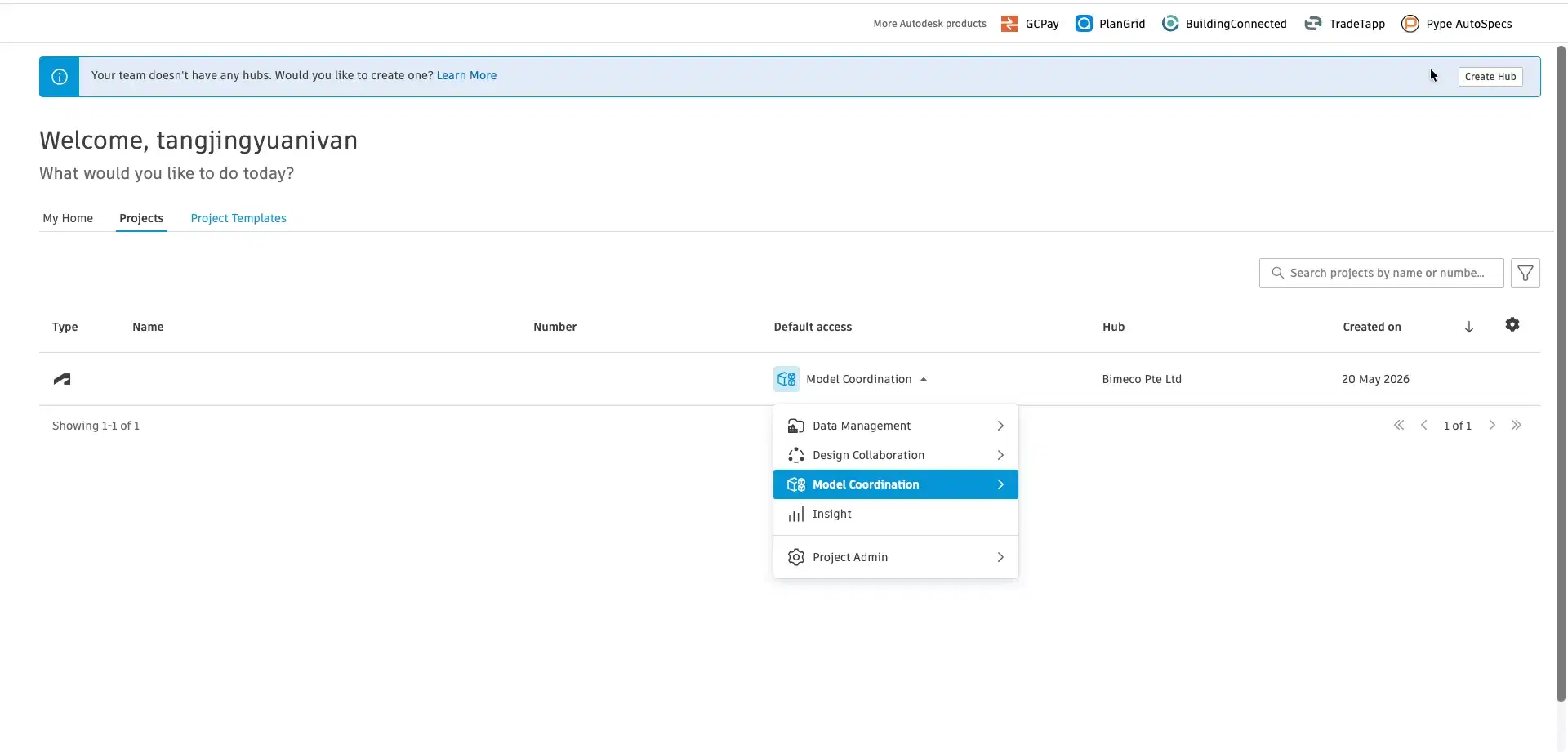
Most outsourced BIM engagements in Singapore use Forma for Construction as the CDE. The module toggle determines which capabilities each team member can access.
As a main-contractor, you may want to own the development of BIM models within your Scope of Work, and define clear standards for your subcontractors. Having a custom BEP ensures that subcontractors follow your internal BIM standards, and is essential for project coordination and handover.
3. Coordination and clash resolution
The outsourced team runs clash detection across the federated model, chairs ICE (Integrated Concurrent Engineering) sessions, and maintains the clash register. Each clash is logged with element IDs, responsible discipline, resolution deadline, and closure status. On a typical building project, a fortnightly coordination meeting might review 200 to 400 active clashes.
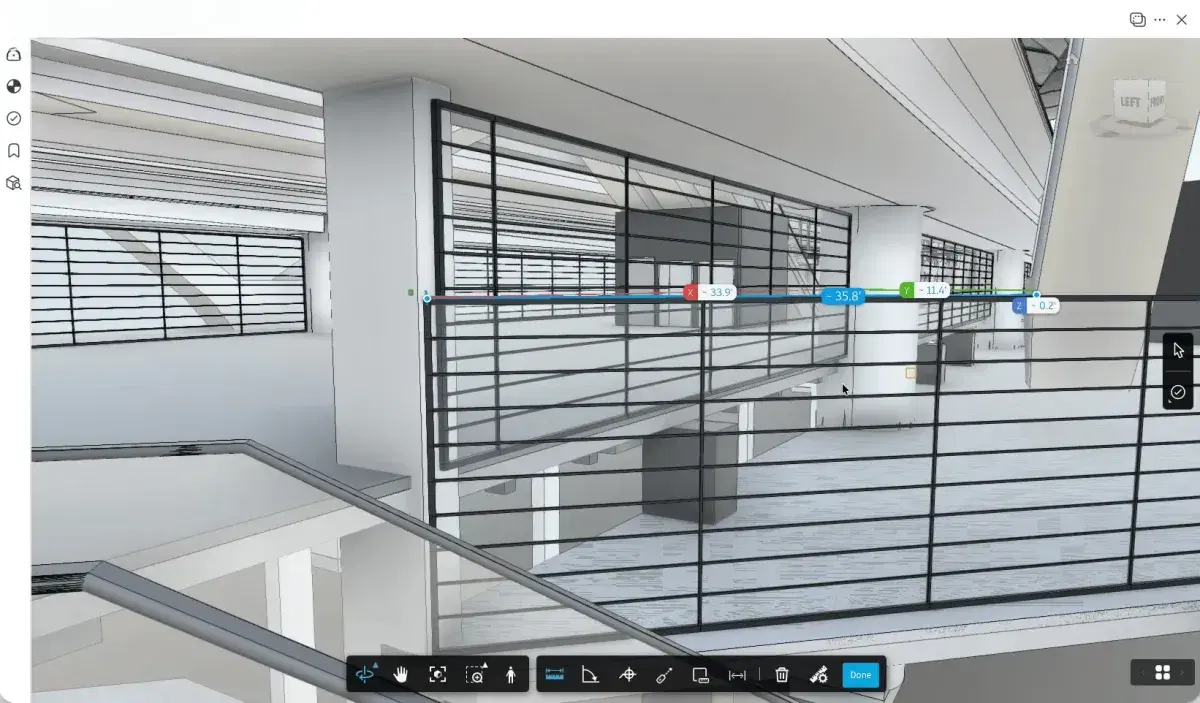
The Model Coordination interface in Forma Design Collaboration lets the outsourced team review the federated model and pin issues directly to elements for resolution.
Conducting weekly clash reviews helps main contractors build twice - once virtually and again on-site. The goal here is to develop BIM models from CAD plans early, and to anticipate issues before they happen on-site where the margin for error is smaller.
4. CORENET X submission
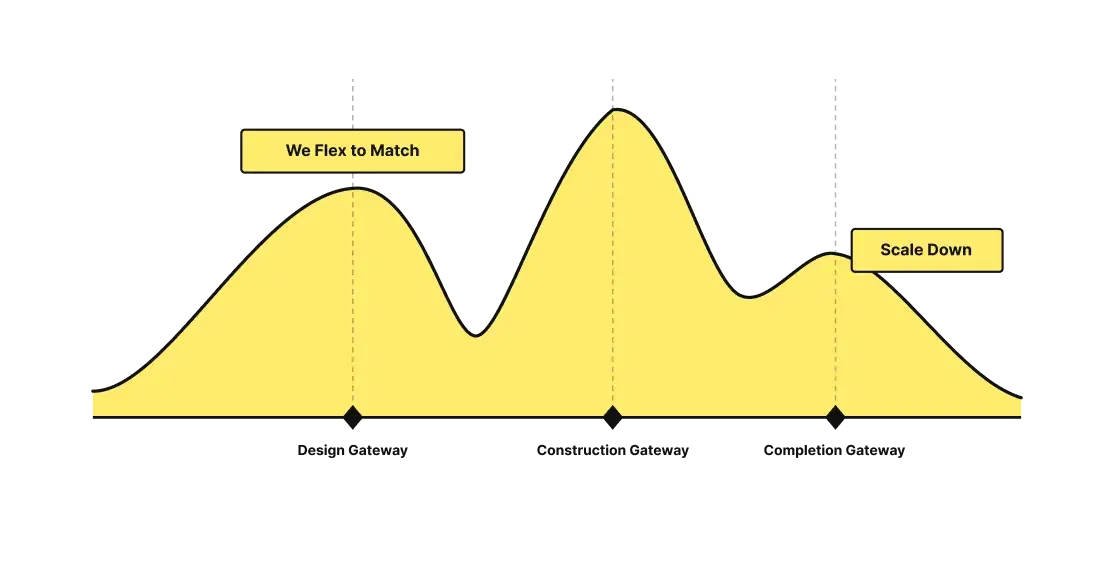
CORENET X requires BIM submissions at three gateways: Design, Construction, and Completion. For most outsourced engagements, the Construction Gateway is the critical one. It requires additional IFC+SG parameters beyond the Design Gateway, and all discipline models must be coordinated with clashes resolved. Main contractors should obtain the native BIM models from the consultant early, as embedded data often needs to carry over to this stage.
Before submission, the team validates models against IFC+SG requirements using automated checking tools. The IFC files are then packaged and handed to the Qualified Person (QP) for submission through the CORENET X portal. Only the QP can submit; the BIM team's role is to ensure models pass validation on first attempt. For a full breakdown of gateway stages, see our CORENET X guide.
5. Construction support and change management
During construction, the outsourced team updates models to reflect design changes, supports site teams with model access on tablets, and maintains the federated model as the single source of truth for coordination. Design changes are issued through the CDE with version control, not via email or ad-hoc file sharing.
Most outsourced BIM engagements in Singapore use Forma for Construction (previously Autodesk Construction Cloud) as the CDE due to its native support for Revit and AutoCAD. With Forma Data Management, main contractors can mark up CAD plans and PDFs extracted from the BIM models directly in the CDE. During this stage, models and accompanying drawings are updated together, and the CDE facilitates easy retrieval of the latest issued drawings.
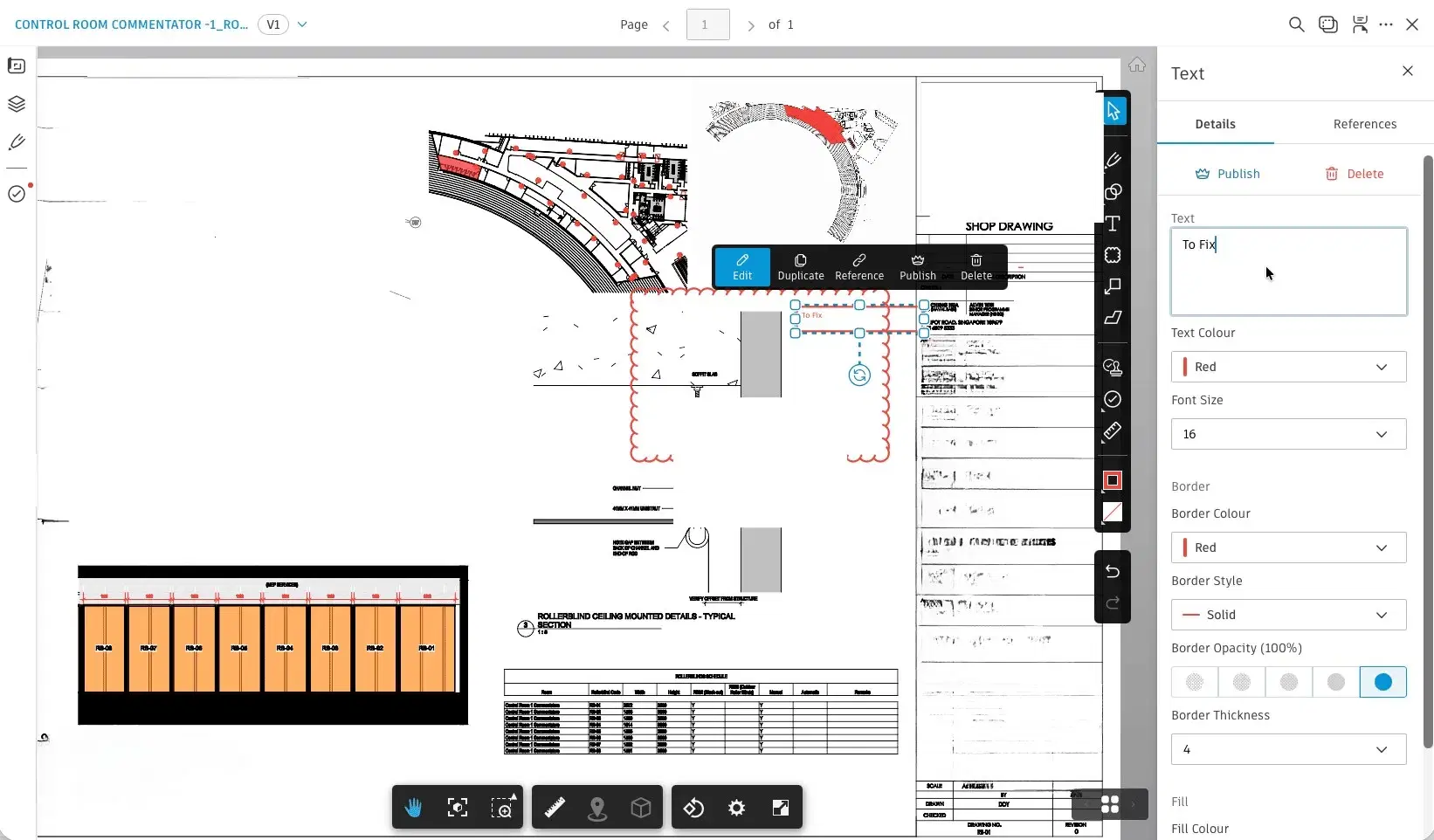
Forma Data Management provides markup and annotation tools that let clients review deliverables directly in the CDE, without needing BIM authoring software.
6. As-built and handover
The team compiles the as-built model at LOD 500, enriched with facilities management data: equipment schedules, warranty periods, maintenance intervals, and O&M document links. The as-built model is submitted through CORENET X at the Completion Gateway and handed to the building owner for ongoing operations. This as-built model can serve as the foundation for a digital twin if the owner chooses to extend it post-handover.
Responsibilities of a service provider
The six stages above describe the visible workflow. But the quality of an outsourced BIM engagement is determined by the invisible work that runs behind each stage.
IFC+SG parameter mapping. Every element in the model must carry the correct IFC+SG parameters for the relevant government agency (BCA, URA, NEA, LTA, PUB, SCDF). A typical BIM model submitted without pre-validation contains up to 5,000 IFC+SG parameter errors. Each error requires manual correction. The Bimeco Validator was built specifically to reduce this correction time.
Internal QA cycles. Before any model reaches your desk for review, a competent outsourced team runs multiple QA passes: geometry checks, parametric checks, and compliance checks against the BEP's LOD matrix. You do not see these cycles, but they are the difference between a model that passes CORENET X on first submission and one that triggers a rejection and weeks of rework.
Issue triage. Not all clashes are equal. The outsourced team must distinguish between critical clashes that block procurement or fabrication and minor clearance issues that can be resolved during construction. Poor triage wastes coordination time on low-priority issues while critical conflicts go unresolved.
This backstage work is the differentiator between outsourced BIM teams. Most providers can produce a model that looks right in a viewer. Few can consistently deliver one that passes regulatory validation on first submission.
Where outsourced BIM fails
The most common failure points in outsourced BIM delivery are predictable and preventable.
Late or poor-quality subcontractor models. M&E subcontractors in particular often submit models late or at insufficient LOD. This compresses the clash detection timeline and pushes unresolved conflicts into construction, where they cost significantly more to fix.
Issues raised but never closed. Clashes and coordination issues are logged in the register, discussed in ICE sessions, and then left open. Without formal closure tracking and escalation, the clash register becomes a growing list of unresolved problems rather than a tool for project delivery.
Non-compliant IFC+SG caught only at submission. Teams that defer IFC+SG parameter validation to the final gate check discover thousands of errors when it is too late to fix them without delaying the submission. Compliance checking must be continuous, not a one-time event.
Version drift. Multiple teams working from different model versions because the CDE workflow is not enforced. One subcontractor coordinates against revision C while another is working on revision E. The federated model becomes unreliable.
These failures matter because poor model quality routinely triggers written directions and rework. Self-checking before submission is not a nice-to-have; it is the only way to avoid delays that cascade through the construction programme.
Tips for successful BIM implementation
Across projects, three moments disproportionately determine whether outsourced BIM delivery succeeds or fails.
Day-one mobilisation. If the CDE is not live, the BEP is not agreed, and the LOD matrix is not defined within the first two weeks, every downstream activity starts on a weak foundation. Bimeco provides a BEP template for teams to reference based on best practices.
Scope definition. Failing to define what is within your scope of work is a common cause for failure. It helps when consultants, main-contractors, and subcontractors define their scope of work early, so that the BIM team can come up with an implementation plan that is aligned to their project schedule.
Issue resolution. One common mistake is failing to address issues (i.e. clashes, missing drawings, point cloud files). In our experience, it is easy for teams to be overwhelmed with information, which is why it is essential for teams to leverage the "Issue Management" features that are typical of most BIM CDEs.
In-house, outsourced, or hybrid?
The decision depends on your firm's BIM maturity, project pipeline, and the regulatory requirements you face.
| Factor | In-house | Outsourced | Hybrid |
|---|---|---|---|
| Best for | Firms with steady project volume and existing BIM capability | Firms without in-house BIM capacity or facing a CORENET X deadline | Firms with some BIM capability but needing specialist support for submissions |
| Cost model | Fixed headcount (salary + software + training) | Variable (project-based or man-month) | Mixed |
| Control | Direct | Requires governance framework | Split between internal oversight and external delivery |
| Risk | Capacity gaps during peaks; skill gaps in IFC+SG | Dependency on provider quality; knowledge leaves with the team | Coordination overhead between internal and external teams |
For most Singapore contractors and developers facing the October 2026 CORENET X deadline, a hybrid or fully outsourced model is the practical path. Building an in-house team from scratch takes 12 to 18 months; engaging an outsourced team takes two weeks. For a deeper comparison on choosing a BIM outsourcing provider, see our guide on evaluating service providers.
The bottom line on outsourced BIM
Outsourcing production does not mean outsourcing accountability. Three things separate engagements that deliver from those that do not.
A live CDE from day one. Every model version, drawing issue, clash report, and design change must live in one place with version control and an audit trail. If teams are emailing files or issuing changes verbally, control has already been lost. Forma for Construction is preferred in Singapore due to its wide adoption amongst consultants, builders, and specialist trade contractors.
Continuous compliance checking. IFC+SG parameter validation runs during model authoring, not as a gate check before submission. Tools like the Bimeco Validator flag parameter errors as they are introduced, not after the model is complete.
Rapid Issue Resolution You should be able to see, at any point, how many coordination issues are open, how many were closed this period, and which ones are overdue. If you have to ask the outsourced team for a status update, the reporting framework is not working. Ensure you have direct visibility into the Issues Dashboard to hold outsourced BIM teams accountable. Most outsourced BIM engagements fail not because the provider lacks technical skill, but because the client lacks a governance framework to hold them accountable. If your provider cannot meet these conditions, the engagement will cost you more in delays and resubmissions than it saves in headcount.
Frequently Asked Questions

Related Articles
Virtual TOP (VTOP) Singapore: A Main Contractor's Guide
What Virtual TOP is, whether it is mandatory, which projects qualify, the camera BCA expects, the five-step process, and which platform to use.
BIM for Project Owners: Benefits and Use Cases
How BIM gives a project owner visibility, cost control, and faster decisions across the lifecycle, even when the project is already over budget.
BIM Collaborate Pro Is Now Forma: What Changed (2026)
Autodesk renamed ACC and BIM Collaborate Pro to Forma for Construction in March 2026. See the full name mapping, module comparison, and SGD 1,700/yr pricing.