- Published on
- • Updated on
CORENET X BIM Requirements & Timeline (2026 Guide)
Key Takeaways
- From 1 October 2026, all new building projects must submit BIM models through CORENET X
- Failing to structure BIM properly can result in written directions. Multiple written directions risk resubmission fees that can reach 5 figures and delay project permits
- Validate each discipline model against IFC+SG requirements before it reaches the lead consultant / project coordinator. Try the free IFC+SG Validator
CORENET X is a multi-agency effort to streamline the regulatory approval process in Singapore. The agencies involved include BCA, URA, NEA, LTA, and PUB. One of the key features of CORENET X BIM submissions is the standardization of data structure in the IFC+SG format. This ensures that agencies have the necessary information on hand to approve projects.
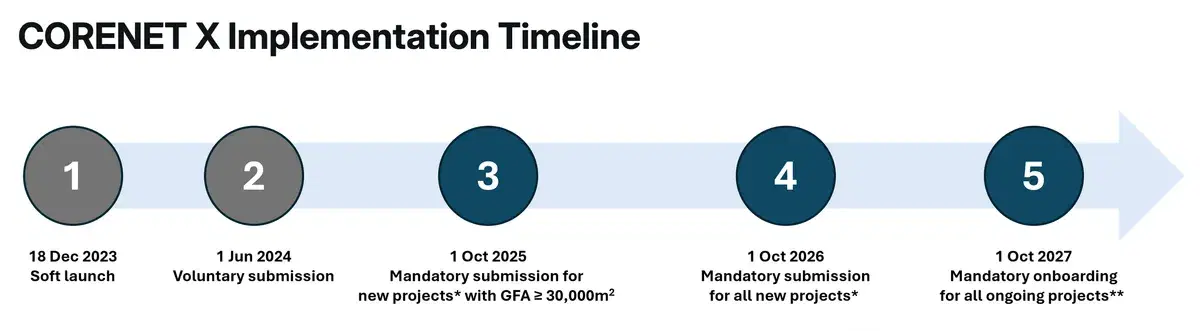
From 1 October 2026, all new building projects will require BIM submission via the CORENET X portal. This article explains what CORENET X is, who needs to submit, and how you can prepare for it.
What is IFC+SG?
Industry Foundation Classes (IFC) is a standard maintained by buildingSmart, an international organization. It provides a common data schema that enables different BIM software to exchange information. However, the international IFC4 schema has limitations—different jurisdictions have unique data requirements that cannot be fully captured in a common file format.
IFC+SG is Singapore's extension of the internationally-recognized IFC4 schema. It contains additional parameters required by Singapore's regulatory agencies to issue construction permits. Property sets prefixed with SGPset_ are Singapore-specific and will not exist in standard IFC templates—your BIM authoring tool needs the IFC+SG mapping configured before export.
For example, BCA requires accessibility features to be captured in the BIM model to ensure that new buildings are designed accessibly for disabled users. URA requires earthworks area using SGPset_GeographicElementDimension. PUB and NEA require mechanical and electrical parameters through SGPset_DuctSegmentType and SGPset_PipeSegmentType.

The complete mapping of agency requirements to IFC+SG parameters is available in the industry mapping table, which contains the full set of parameters needed by each regulatory agency.
When Are BIM Submissions Mandatory?

From 1 October 2026, all new building projects must submit BIM models through the CORENET X portal. The October 2026 deadline disproportionately impacts architects and consultants, who lead the Design Gateway submissions. Main contractors and builders will face growing pressures subsequently, as Construction and Completion Gateway submissions require their discipline models to meet the same IFC+SG standards.
Often, the Architect acts as the Project Coordinator to federate the BIM submissions and submit them via the CORENET X web portal. The four key gateways for BIM submission are: Design Gateway, Piling Gateway, Construction Gateway, and Completion Gateway.
Each gateway has specific BIM requirements. It is essential for the Project Coordinator to ensure that the BIM models at each gateway contain the necessary parameters for BIM submission. For a detailed comparison with the previous system, see CORENET X vs CORENET 2.0.
Who is Affected?
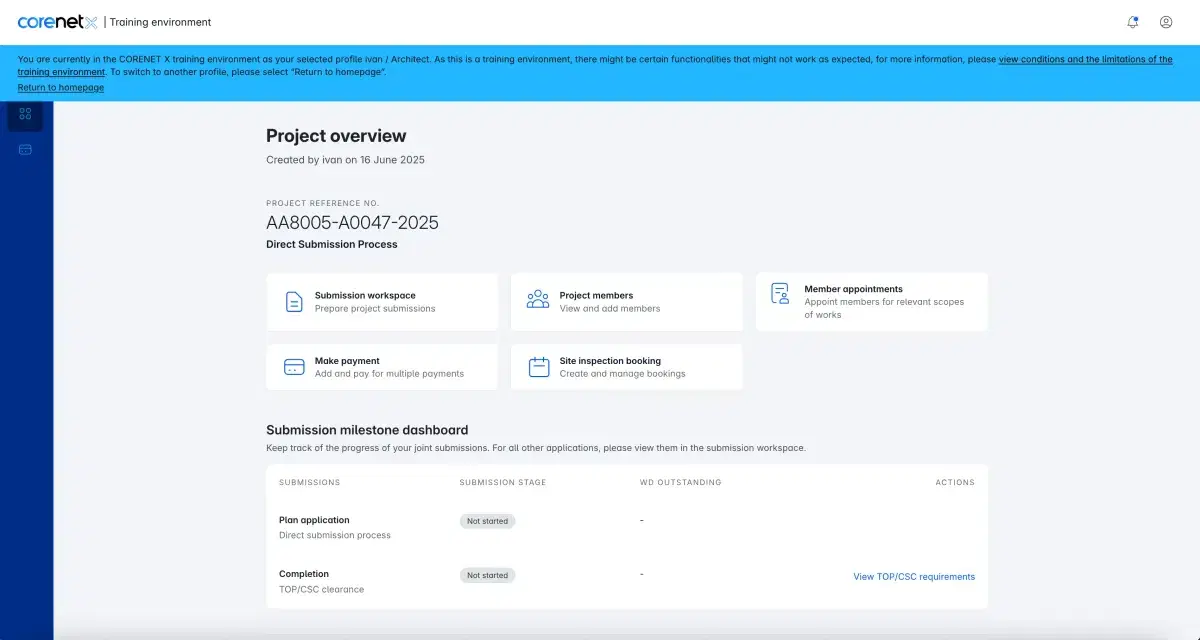
The Qualified Person (QP), typically the Architect, acts as the Project Coordinator. The QP federates discipline-specific BIM models from all consultants and submits the consolidated model through the CORENET X web portal. Sub-consultants are not direct submitters, but they are not off the hook.
Each contributor produces an IFC+SG-compliant model for their respective scope. Those models are then coordinated and submitted through the Project Coordinator. This responsibility cannot be deferred to the Project Coordinator, because the BIM models contain essential information that can only be best understood by the responsible consultant.
Some things to look out for include:
- No Clash — The federated model must be free of physical conflicts between disciplines. A duct running through a structural beam or a pipe clashing with a cable tray will flag during automated checks and stall the submission.
- IFC+SG Data — Each discipline model must include the correct IFC+SG property sets for its scope. For structural engineers, a frequent issue is
SGPset_Slabwith missingConstructionMethodvalues. For M&E consultants,SGPset_DuctSegmentTypeandSGPset_PipeSegmentTypeare commonly missing. - Code of Practice Compliance — Models must meet the requirements set out in the CORENET X Code of Practice, including the correct Level of Detail and data inputs at each Gateway stage.
What Happens if a CORENET X Submission Fails?
When data is not structured in the format expected by CORENET X, it triggers the risk of a Written Direction. Multiple written directions may require having to re-apply for a CORENET X submission, incurring resubmission fees that can rise to 5 figures.
More critically, a failed submission will inevitably impact project schedules, as the necessary permits to begin work are delayed. This can increase project costs as more time is required by each consultant to prepare for a new submission.
How to Prepare
BCA has worked with key software vendors such as Autodesk, Trimble, Graphisoft, and Bentley Systems to develop export guides. Each vendor provides specific resources to ensure exported models include the necessary IFC+SG parameters.
For non-BIM users such as project consultants, the CORENET X Sandbox provides training on the overall submission workflow. IFC+SG training courses are also available for teams that need to understand the data requirements.
For consultants that need to scale BIM teams quickly, or don't wish to grow this capability internally in the near term, working with Managed BIM Services firms can help you meet tight submission deadlines.
How Do You Validate BIM Models for CORENET X?
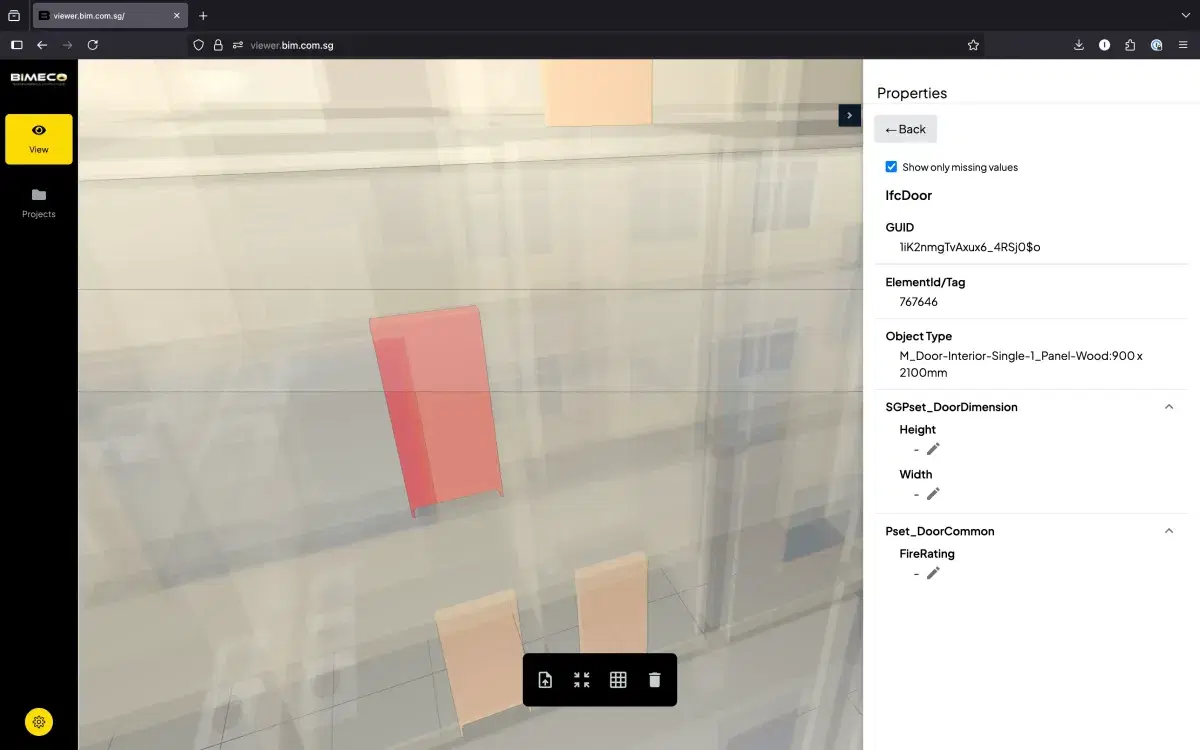
A BIM model can look complete in 3D and still fail every automated check. The geometry might be fine, but the underlying data is where rejections happen—missing property sets, wrong parameter values, or clashes that only surface during automated checks.
The practical safeguard is validating each discipline model against IFC+SG requirements before it reaches the lead consultant. In our benchmark tests, a typical BIM model contains up to 5,000 IFC+SG parameter errors that need to be corrected before CORENET X submission. These errors can take up to a week to resolve manually.
The Bimeco Validator is a free tool designed to support consultants and contractors with CORENET X compliance. Key features include model federation, IFC+SG parameter checking, clash detection, and in-browser editing of parameters directly without returning to your authoring software. For more on how the validator works, see Bimeco Validator for CORENET X.
Next Steps
CORENET X marks a significant step in Singapore's regulatory digitalization. The shift from 2D drawings to 3D BIM models enables more efficient reviews, better coordination, and automated compliance checking.
With mandatory submissions starting 1 October 2026, firms should prepare early—whether through in-house teams or external providers—to avoid last-minute complications and ensure smooth regulatory approval.
For firms needing support with CORENET X submissions, contact our BIM team to discuss how we can help you prepare compliant models for regulatory approval.
Frequently Asked Questions
Table of Contents
Authors

Need Help with CORENET X Submissions?
Related Articles
BIM Execution Plan Template for Singapore Projects: Free Download (CORENET X Ready)
Download a free BIM Execution Plan template built for Singapore projects. 32-page PDF covering CORENET X workflow, IFC+SG, clash detection, ISO 19650 CDE, and LOD progression.
What Does a BIM Consultant Do for an Architect or Engineer in Singapore? (2025)
Full scope of a BIM consultant on architect and engineering consultant projects in Singapore — covering EIR authoring, Design Gateway CORENET X, clash coordination at design stage, and handover strategy.
What Does a BIM Consultant Do for a Main Contractor in Singapore? (2025)
Full scope of a BIM consultant on Singapore main contractor projects — covering BEP, clash detection, CORENET X, 4D/5D/6D BIM, and as-built handover.