- Published on
From IFC to AI: Why Clean BIM Data Matters for Automation
Key Takeaways
- A model can look correct in a viewer and still contain poor data underneath: wrong IFC classification, missing properties, or information lost during export.
- Automation does not fix bad data, it exposes it. Software cannot reliably find or evaluate information that is not classified and structured consistently.
- Many BIM validation tasks are deterministic and belong to rule-based checking, not AI. The strongest workflows combine structured data, validation rules, automation and AI.
- As CORENET X moves Singapore toward digital regulatory submission, a model cannot just look correct. It has to contain what an automated system needs to evaluate it.
Clean BIM (Building Information Modeling) data is model information that software, not just people, can classify, interpret and check reliably on its own. Artificial intelligence (AI) is creating new possibilities for how BIM information can be searched, checked and used, but before AI can answer questions about a model, identify issues, automate checks or support downstream workflows, there is a more basic requirement: the information inside the model has to be understandable by machines.
That sounds obvious, but many BIM models are created primarily for human use. A modeller can often understand what an object represents by looking at its geometry, location or context. Software does not have that luxury. For automation to work reliably, building information needs to be classified, structured and stored consistently. This is why clean BIM data matters.
A BIM Model Can Look Correct and Still Contain Poor Data

A model may appear perfectly usable in a viewer while containing information problems underneath. For example:
- an object may be assigned to the wrong IFC class
- required properties may be missing
- the same information may be stored under different parameter names
- values may be inconsistent between disciplines
- a property may exist but contain the wrong data type or value
- information required for submission may never have been mapped into IFC
- the correct information may exist in the authoring model but disappear during export
A human reviewing the model visually may not notice any of these problems. But a checking system, data workflow or AI application will. That creates an important distinction: model quality is not only about geometry. It is also about information quality.
IFC Turns BIM Objects Into Machine-Readable Information
Industry Foundation Classes (IFC) provide a standardised way of representing building objects and their information. Instead of relying solely on how something looks, software can identify what type of object it is, which properties it contains, how it relates to other objects, where it belongs within the building structure, and what systems or spaces it forms part of.
This makes IFC useful far beyond model viewing. Structured IFC data can support model validation, regulatory checking, coordination, asset information management, analytics, interoperability between systems, automated workflows and AI-enabled applications. But these possibilities depend on the information being represented correctly. An IFC file is not automatically good data simply because it is an IFC file.
Why IFC+SG Raises the Importance of Data Quality
Singapore's move toward CORENET X increases the importance of this distinction. That requirement comes with a name: IFC+SG, Singapore's extension of the IFC4 schema that adds the regulatory properties agencies need to review a submission. For digital regulatory workflows, project teams need to provide information in ways that software can recognise and evaluate.
That means a model cannot simply look correct. Relevant objects need to be classified appropriately and contain the information required for downstream checking. If a required property is missing, incorrectly named or assigned to the wrong object, an automated system may not be able to evaluate it correctly. This creates a new responsibility for BIM teams: we need to think not only about what people see in the model, but also about what machines can understand from it.
Validation Should Happen Before Submission
One of the most useful ways to improve BIM data quality is to validate information before it reaches the next stage of the workflow. A validation process can check questions such as:
- Are objects classified correctly?
- Are required property sets present?
- Are mandatory properties populated?
- Are values within the expected format?
- Are standardised terms being used consistently?
- Has information been mapped correctly during IFC export?
Finding these issues before submission or downstream processing is significantly more efficient than discovering them later. It also helps teams distinguish between two very different types of problem:
A modelling problem: the information was never created correctly. An exchange problem: the information existed in the authoring environment but was lost or transformed incorrectly during export.
That distinction is important because the solution is different in each case: a modelling problem usually needs a change at the source, in how the object was built or parameterised, while an exchange problem usually needs a change to the export mapping, the property set template, or the IFC export settings, not the model itself.
Clean Data Is the Foundation of Automation
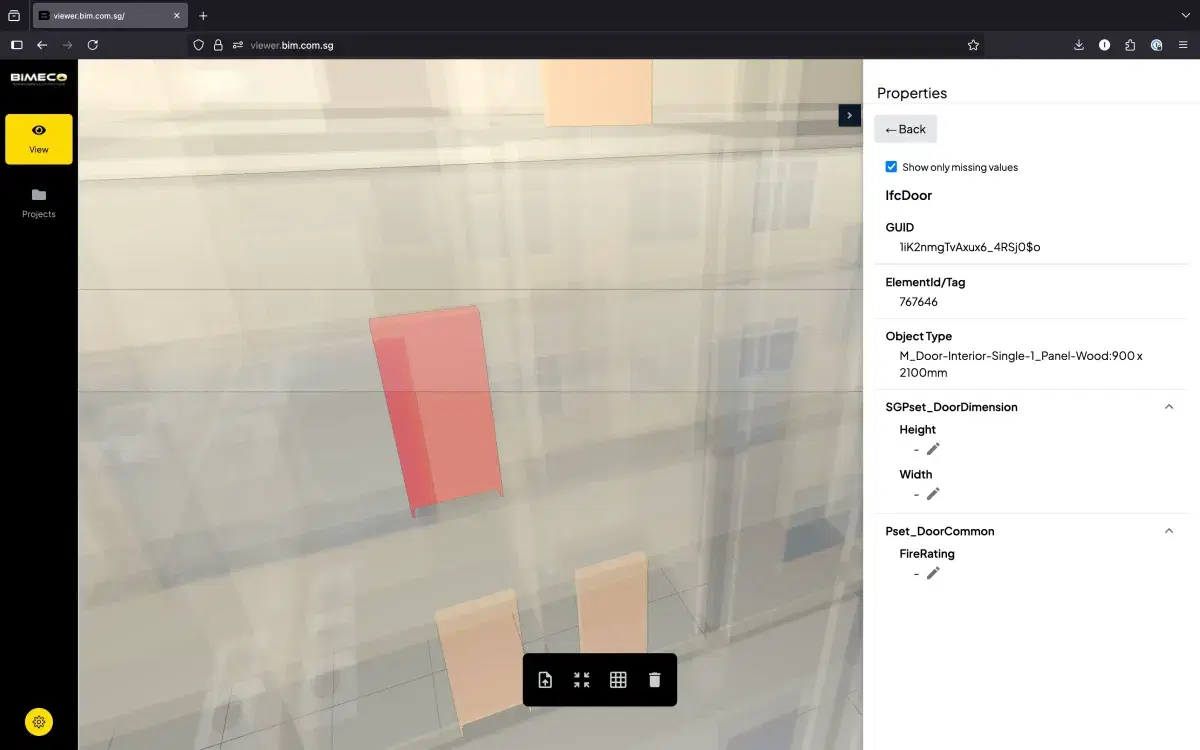
Many automation workflows follow a simple principle: identify an object, retrieve the relevant information, compare that information against a requirement, return an outcome. For example, software may need to identify a door, retrieve a particular property and compare its value against a defined requirement. That workflow becomes unreliable if the software cannot confidently determine which objects are doors or where the required property is stored. If the property is scattered across three differently named property sets, duplicated at two stages of the model, or never exported at all, the automation has no way to compare like with like.
This is why structured information is so important. Before asking:
"Can this process be automated?"
we should first ask:
"Can software reliably find and interpret the information needed to automate it?"
Rule-Based Checking and AI Solve Different Problems
The rise of AI does not mean all model checking should become AI-driven. Many BIM validation tasks are deterministic. If a required property is missing, software can check whether it exists. If a value must follow an agreed list, software can compare the model against that list. If an object must be classified in a particular way, a rule can verify the classification. These checks, the kind rule-based model checking already handles well, are explicit, repeatable and auditable.
AI becomes useful around these workflows in different ways. It can help users search model information using natural language, understand unfamiliar IFC terminology, interpret checking results, identify patterns across large datasets, retrieve relevant guidance, and navigate complex model information more quickly. The strongest digital workflows therefore combine structured model data, validation rules, automation and AI, rather than treating AI as a replacement for everything that came before.
AI Makes Clean Data More Valuable, Not Less Important
Generative AI is often associated with unstructured information because large language models are good at working with natural language. But when AI is applied to BIM, structured information becomes particularly valuable. Consider questions such as:
- Which doors are missing a required property?
- Show all elements using a particular classification.
- Which objects contain inconsistent values?
- Which elements do not meet a defined information requirement?
- Which model components belong to a particular system?
- Which properties need to be corrected before submission?
These questions become much easier to answer when the model information is structured consistently. AI can make accessing that information more intuitive, which is also where we see the near-term value of AI in the Bimeco Validator roadmap: helping teams understand which parameters matter, not replacing the checks themselves. AI does not eliminate the need for reliable underlying data.
From Model Files to Usable Building Information
The industry is gradually moving away from treating BIM only as a collection of large proprietary files. Increasingly, the objective is to make the information inside those models more accessible: able to be inspected, searched, validated, edited, connected, and used to automate processes. Once that happens, BIM information becomes useful to many more applications. The model is no longer only something to open and view. It becomes a source of structured data that other systems can use, from a digital twin built from the same project to a facility management platform the owner runs after handover.
What Should Teams Check Before Using BIM Data Downstream?

A practical starting point is to assess several basic areas.
Classification
Are model objects represented using the appropriate IFC entities and predefined types?
Information Completeness
Do the required objects contain the necessary property sets and properties?
Value Consistency
Are names, formats, units and permitted values being used consistently?
Export Quality
Has information from the authoring platform been transferred correctly into IFC?
Searchability
Can information be found without manually inspecting every object?
Validation
Can the data be checked systematically against agreed requirements?
These steps improve model quality regardless of whether AI is involved. But they also create the conditions required for more sophisticated automation later.
From IFC to AI
The progression can be thought of simply: BIM creates information. IFC makes that information interoperable. Validation improves its reliability. Structured data makes it machine-readable. Automation makes it actionable. AI makes it easier to interrogate and use.
Each layer depends on the one below it. That is why preparing BIM data for AI does not begin with an AI model. It begins with better information.
At Bimeco, we are focused on making BIM information easier to inspect, validate, search and use. Bimeco Validator helps teams examine IFC model data, identify missing or inconsistent information, understand model structure and improve information quality before that data moves into downstream processes.
As BIM workflows become increasingly automated and AI-enabled, the value of clean, structured and accessible model data will only increase. Before asking what AI can do with an IFC model, first make sure the IFC model contains information that machines can reliably understand.
Frequently Asked Questions
Table of Contents
Authors

Check Your Model Before It Reaches CORENET X
Related Articles
Outsourced BIM Services in Singapore: CORENET Submission, Coordination, and Handover
How outsourced BIM delivery works in Singapore, stage by stage. Covers CORENET X submission, design & construction implementation, and project handover.
Faster Permits, Fewer Reviewers: The Case for Model-Based Permitting
U.S. building departments face staffing shortfalls, retirements, and rising demand. Model-based permitting using BIM and IFC can cut review cycles and scale with fewer reviewers.
BIM Execution Plan Template for Singapore Projects: Free Download (CORENET X Ready)
Download a free BIM Execution Plan template built for Singapore projects. 32-page PDF covering CORENET X workflow, IFC+SG, clash detection, ISO 19650 CDE, and LOD progression.